
Belle (2021)

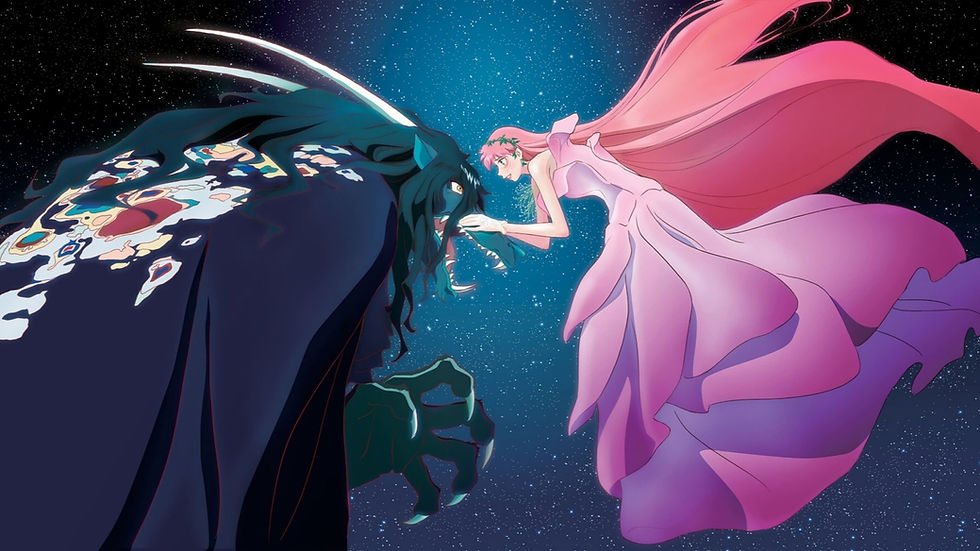
Conceptually, social media is supposed to be "good" for people. The idea of a utopian society where anyone can be whoever they want without fear of ridicule or persecution, because everyone is supposedly starting from the same level ground. Obviously, that isn't the case, and never has been. I'm an elder millennial, so early social media platforms like AOL Instant Messenger, early Facebook, and MySpace were essentially built for me and my generation; I watched the whole experiment in real-time identity from the ground floor. And while I still actively use some platforms, I try not to maintain much of a public persona online beyond this rarely-read blog and my Letterboxd account. I learned a long time ago that the version of you that lives online tends to calcify into something you didn't necessarily choose, so I've kept mine small on purpose. "U," the virtual world in Belle, takes that whole anxiety and makes it literal: users inhabit an avatar they can use to behave however they choose, but unlike the fabricated, ethereal personas we currently traffic in, this one runs a bio-genetic snapshot of the user's actual physical appearance and re-contextualizes it into the world. So wounds show up in real life, and they show up in "U" too. There's no real anonymity here, just a prettier mirror, and the film is smart enough to know that's the more interesting premise than pure escapism would have been.
This is, surprise, a Beauty and the Beast retelling, but muddied up with real-life baggage that bleeds in and out of the virtual world rather than staying neatly on one side of the screen (and no singing furniture). A grieving girl named Suzu, essentially mute since she watched her mother die saving a stranger's kid, finds her voice again inside this virtual world, where she becomes the singing sensation Belle and falls into the orbit of a feral, ostracized user everyone calls the Dragon, who (spoiler alert) turns out to be a junior-high kid named Kei, taking the beatings his father can't land on his little brother instead. There's a vigilante mob hunting the Dragon to unmask him, led by a self-appointed justice type who's exactly as insufferable as that description suggests, a school subplot with Suzu's friends pairing off that the film clearly cares less about than it pretends to, and a back half that trades the dazzling concert sequences for something much smaller and harder to watch: a kid trying to save another kid from his own house, with the clock running because the law won't move for forty-eight hours. That tonal whiplash, the jump from a glittering CG pop spectacle to a kid quietly absorbing his father's anger, is either the film's boldest swing or its biggest miscalculation, and I went back and forth on which the whole runtime.
I won't pretend the metaphor stayed subtle for me; the "abandoning her for a stranger's child" wound and the mother's sacrifice are so blatant by the end that the film all but underlines it twice and circles back to make sure you caught it the first time. There's a moment late on where the parallel gets spoken almost out loud; the film loses faith in its audience, like it didn't trust the shape it had already drawn so clearly. Still, I'd rather a movie reach too hard for its meaning than not reach at all, and the parts that worked, Kei's distrust of anyone offering help, the brother who refuses to give up on him, the quiet after the rescue, worked because they didn't feel artificial at all. Those scenes slow down and let silence do something, which is rare for a film this visually loud. There's a real ache underneath the spectacle, even when the spectacle is doing its best to drown it out.
That being said, this is overstuffed and loses the thread a lot. It has standard frantic reactions from some of its human characters (this Kamishin kid is a nightmare with a kayak, and I mean that as a description, not a compliment, the kind of comic-relief energy that feels imported from a different, broader movie), and Suzu's best friend (and Belle's manager) Hiroka is apparently some sort of tech genius with a full surveillance setup she can pull out of her box backpack, which is the kind of detail you either roll with or you don't. I mostly rolled with it, because the movie has the good sense to spend its real attention elsewhere, even if I couldn't tell you what Hiroka's actual personality is supposed to be. The school-friends-pairing-off subplot gets a similar pass from me; it's clearly there to give the human world some stakes of its own, but it never quite earns the screen time it's given. It takes some swings and doesn't cleanly land a lot of them, and feels like three movies crammed into one. But it's perfectly entertaining enough.
3 out of 5 Stars


Comments